

Artificial Intelligence is fundamentally transforming lead management. As a key success factor, AI not only enables automation from Lead Generation in Organizations to conversion but also delivers decisive competitive advantages. Modern companies are already using this technology for more precise lead evaluations, individualized customer approaches, and data-driven decisions in real time. But how can this potential be tapped into concrete terms?
Fundamentals and Definitions of AI:
Artificial Intelligence is a technology which makes machine to perform Tasks like Humans, Learning, Problem solving, and decision making in Industry. This is different from the rigid rule-based systems, AI can learn and record data from the individual task also it can recognize patterns and continuously improve without Explicit programming.
Significance of AI in Lead Management:
- Machine Learning: Algorithms analyze historic and real time data to make predictions (Example Lead Scoring which ranks potential buyers by assigning point values based on their profile and online behavior.) The more frequently a customer/lead interacts with online marketing content the higher predicted possibility of them getting converted into a buyer.
- Natural Language processing (NLP): Processes and Interprets the Human language for example Emails, chats and Phone calls. The application of this can be understood by the way Automatic Characterization of the customer enquiries or sentiment analysis in call transcript.
- Deep Learning: Complex neural networks recognize even the finest patterns of unstructured data. The benefit of Deep Learning is the understanding of buying signals in Individual customer interactions.
Impact of AI on sales strategies in an organization:
AI plays a major role in changing the nature of selling methods from intuition-based to data-driven approaches. AI has changed how businesses operate as well as to serve their customers. Introduction to the Topic
Data-driven decision making and more accurate customer forecasts:
- Real-time Operations: AI constantlyevaluates customer data (Example: website behavior, email interactions, call history). It monitors trends that are hidden from Human eye.
- Predictive models: Algorithms predicts purchase probability, customer value or churn risk enabling proactive risk.
Focus on High Quality leads:
- Intelligent Lead scoring: AI does the prioritization of leads based on their conversion probability saving valuable sales resources.
- Automated Segmentation: Leads are divided into groups (Example: “Interested”, “Ready to purchase”, “Follow-up Needed”) these needs are understood and addressed appropriately.
- Advantages: Sales Teams apply Parato Principle which essentially focuses on the fact that 20% of the customers gives 80% of the leads, instead of targeting “cold customers”.
Why is this significant for your sales:
AI- Supported strategies not only reduces wastage of technology but also increase customer satisfaction through relevant and timely communication with relevant customers.
Importance and Benefits of automation on through AI in Lead Management:
AI doesn’t just ensure synchronization of the repetitive process but makes sure that the entire sales process becomes highly efficient and cost effective. Companies using AI-based automation enjoy competitive edge over their rivals.
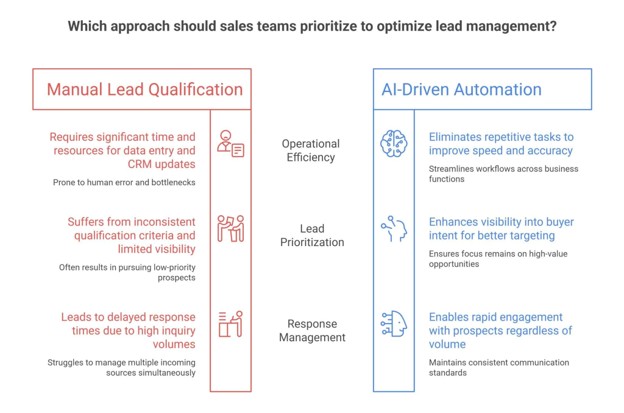
Source: https://www.mygreatlearning.com/blog/generative-ai-sales-teams-ai-agents-lead-qualification/
Time savings and Increased accuracy:
Automated Lead processing:
The AI completes time-consuming jobs like data entry, qualifying leads, and follow-ups on leads without requiring any human intervention. One example of this is when a form that has been filled is sent in, it can be instantly analyzed, tagged, and evaluated in the CRM system.
Emphasis on Value Added Activity:
Sales teams now no longer must do the manual entry of data or so called “Cold Leads”. But can concentrate on building relationships with customers and managing leads.
Cost reductions and minimalization of error:
Reduced Manual efforts:
AI driven processes reduce personal costs for routine tasks such as lead scoring or data maintenance. Which makes things cost effective.
Reduced Human error:
Automated systems work more consistently than Humans, whether in Lead evaluation, appointment scheduling or documentation.
Scalability and 24/7 availability:
AI works round the clock by using chatbots or virtual assistance without even using any other additional workforce.
Conclusion: AI as a strategic success factor for the lead Management in your organization.
AI has transformed from a future topic to a key competitive advantage. The companies that are now utilizing AI for their lead management can have the following advantages:
- Better lead assessment using smart scoring algorithms
- Increased efficiency due to automated processes that perform repetitive tasks
- Tailored approaches to customers based on their behavior
- Making better decisions based on data with proven success
The use of artificial intelligence plays a crucial role in sales competition. Using smart data analysis and personalization, artificial intelligence technology is changing how businesses deal with prospective clients.
References:
Great Learning Editorial Team 2026, Generative AI for Sales Teams: How AI Agents Support Lead Qualification and Follow-Ups, Great Learning, published 24 June, updated 26 June, viewed 7 August 2026
Matelso Platform, 2025, The role of artificial intelligence in modern lead management: Optimize your sales strategy with AI, viewed 6 August 2026