

We are truly living in a VUCA world, dealing with the rise of AI, regional instability, increasing inequality and ever increasing divides in people’s opinions on everything from climate change to immigration.
Leading in this context is challenging. How do you navigate all of these issues and make decisions that will allow your company and above all your people to grow and thrive?
What is the story of ESG?
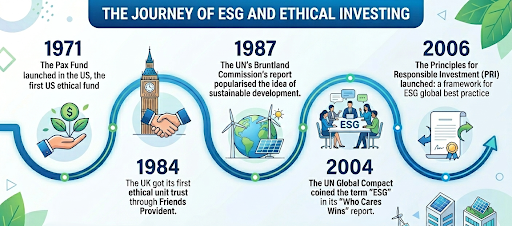
As a leader you are probably familiar with the term ESG (environmental, social and governance) a term which the United Nations Global Compact coined in 2004.
Although this term only emerged in 2004, the roots of ESG started long before as you can see in the key developments timeline below:
What do I need to know about ESG developments in 2026?
The below table outlines examples of some key developments in 2026 that will impact strategic decision making for leaders in many sectors:
| Regulation/ Directive | Impact |
| CSRD and ESRS (Corporate Sustainability Reporting Directive) | If your company is in scope you need to have auditable and data-driven reporting systems |
| CSDDD (Corporate Sustainability Due Diligence Directive) | Large companies now have to carry out environmental and human rights due diligence across their value chain |
| EU Taxonomy Regulation | On Jan 28 2026 significant simplification occurred. Companies will need to check if they meet the new criteria for revised activity descriptions and check that their reporting aligns. |
| ESPR (Ecodesign for Sustainable Products Regulation) | From July 2026 large companies will be banned from destroying certain unsold goods such as clothing. Digital records will be required that contain key traceability data across a product’s life cycle, from raw material sourcing to production and recycling. |
Impact on leadership decisions
In the past strategic decisions regarding ESG might have been driven largely by compliance, and meeting short term goals. The combination of recent global events and tighter regulatory demands as described above means that the drivers of decisions are changing.
As a leader you are probably feeling the tension between more conservative attitudes from some quarters (including institutions who are pushing back on ESG) whilst at the same time needing to show that your company complies with regulations and legislation.
But what if there is a great opportunity here?
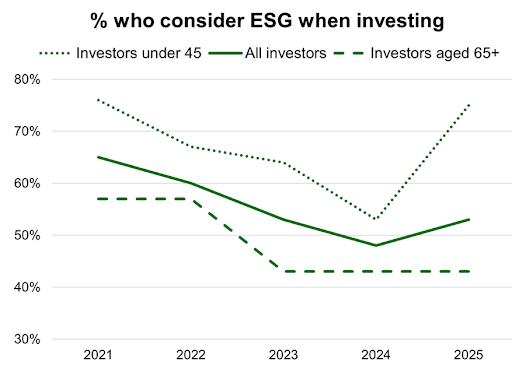
The below graph from the Association of Investment Companies from their ESG Attitudes Tracker (an annual sentiment survey of private investors) shows a shift back to more favourable attitudes towards ESG, particularly for younger investors.
A study by the Centre for Research on Energy and Clean Air found that the clean energy sector was the main driver of economic growth in China in 2023. Solar power, electric vehicles and batteries being the main drivers.
In his 2025 book ‘The Growth Story of the 21st Century’, Nicholas Stern argues that “urgent climate action is not an economic burden but the primary, attractive growth opportunity for the coming decades.”
He points out that as the cost of clean technology drops it provides an opportunity for countries in the Global South and MENA to ‘leapfrog’ and avoid the polluting approaches of the past. He is very clear that we don’t have to choose between ESG and economic development and poverty reduction.
Harnessing the growth opportunities of ESG
The below table shows how you can make strategic decisions in key business areas that can lead to new or increased revenue opportunities:
| What? | Decisions | Impact |
| Product lifecycle | Move to a more circular product life cycle – reducing waste and obsolescence | Lower material costs, new revenue streams, for example, resale and repair |
| GenAI | Invest in AI tools to assist with data collection and analysis whilst keeping a human in the loop. | Reduce time needed to create ESG reports and quickly surface key insights. Reduce inconsistencies and human error when analysing qualitative data. |
| Supply Chain | Implement due diligence practices – carry out supplier audits, risk assessments and be proactive regarding compliance and integrate ESG criteria | Reduce disruption risk, protect reputation and build better relationships with stakeholders |
| Value Chain Mapping | Integrate ESG into your value mapping. Map out the whole lifecycle of our business activities and identify the ESG issues at each stage. | Highlights bottlenecks, risks or redundancy. Potential cost reduction opportunities. Provides insights regarding future developments. Contributes to long term sustainability. |
The sustainable takeaway
ESG is drastically reshaping how we make decisions in 2026 but despite current challenges rapid technological advances will enable leaders to drive change at scale.
You don’t have to choose between the planet and prosperity.