
You have a task to do, one that will need your undivided attention and focus. Keen to get on with it you make a coffee and settle down at your desk. You open the software you need and make a start, suddenly: ‘ping!’ you glance at your phone, hmm… you ought to respond to that message from accounts.
Ok, you start again ‘where was I…. ah yes’. Two minutes later, out of the corner of your eye, you see an email from a supplier arrive. ‘What if that is urgent? I’ll just check’ You read through it and reply.
You then search through the ten tabs you have open at the top of the screen and eventually find the one you are looking for. It takes you 5 minutes to get back into your original task.
This pattern repeats itself throughout your day. You complete the task but not much else. You feel frazzled.
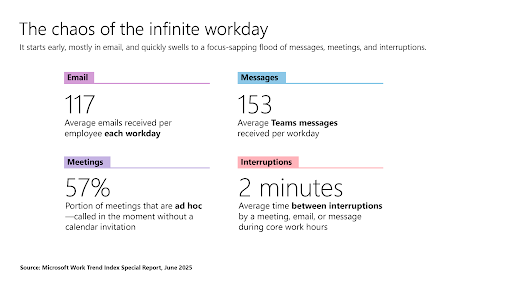
The below statistics from the Microsoft Work Trend Index special Report June 2025 highlight just how much we are being interrupted
That frazzled feeling follows you into your evening. You start cooking. ‘Ping’ a text from a friend interrupts your thoughts, your milk ends up in the cupboard instead of the fridge.
Later you flop on the sofa to catch up with your favourite series…. five minutes later another alert, a great holiday deal, 20 minutes on, you are still scrolling through your phone. You have missed the key plot twist of your series.
Most of your days and nights follow this exhausting pattern.
Something has to change but what and how?
The main finding in a recent study in Computers in Human Behaviour was that a single social media notification can slow down cognitive processing by 7 seconds.
You might think this is not much but the number of alerts we receive daily pushes our minds into a hypervigilant state because we anticipate the next interruption and can’t focus on the task at hand.
Are our attention spans decreasing over time due to technology?
No, according to a Nature article from May 2026. The idea that we are now less able to concentrate due to our ability to pay attention degrading over time is not supported.
What is it that damages our focus? The frequency of interruptions rather than the amount of time we are spending on our screens.
This highlights the need to prioritise minimising those interruptions. Is Digital Minimalism the answer?
What is Digital Minimalism?
Cal Newport popularised this phrase in his 2019 book ‘Digital Minimalism: Choosing a Focused Life in a Noisy World’.
Cal is a Computer Scientist and for him Digital Minimalism is a philosophy that helps us question what digital tools add value to our lives. He maintains that intentionally and aggressively removing low-value ‘digital noise’ and optimising our use of tools that truly add value will significantly improve our lives.
What does Digital Minimalism look like at work?
- Block time for deepwork
- Disable notifications or apps during time you have set aside for deep work
- Put your phone on silent, turn it over and mute notifications during deep work times or even put it out of sight
- Group small quick tasks together e.g responding to emails between a certain time during the day rather than handling them individually
- Take intentional micro breaks
- Only have open what you need for the task you are currently doing
Digital Tools for Digital Minimalism?
- Remove apps from your homescreen – this introduces friction and you are less likely to check them
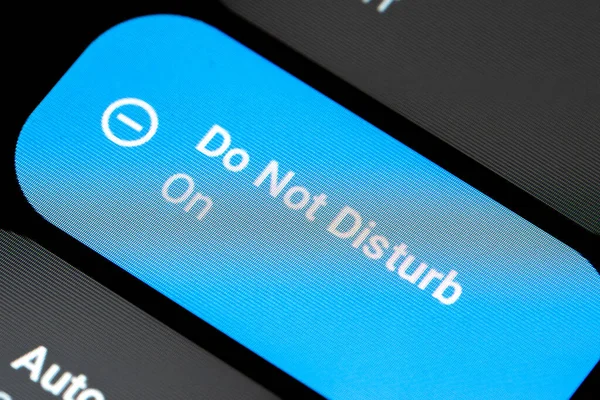
- Use inbuilt tools like Do Not Disturb (Android/iOS) or Focus Modes / Priority Notifications (iOS) to reduce disruption from notifications
- Check your notification history or usage on your phone to find out which apps distract you the most
- Try AI tools like ScreenZen or Fomi to detect when you caught in mindless scrolling and nudge you to stop
The moral case for Digital Minimalism?
Our notifications also have a negative impact on the focus of those near us that can hear or see them.
Simone Weil in ‘Gravity and Grace’ described attention as the “rarest and purest form of generosity”. Enabling ourselves and others to pay attention is therefore also a moral issue not just a cognitive one.
Our attention is held captive by an ecosystem designed to attract and trap it.
As Carl Hendrick says “the deeper question is whether we are willing to treat attention as something worth defending, not just optimising”