

In an era defined by flexibility and rapid change, hybrid work models, where employees alternate between remote and in-office work, are now a defining reality in the professional world. Research from global organisations such as PwC, McKinsey, and the World Economic Forum confirms that hybrid arrangements are not only widespread but expected to grow in strategic importance in the coming years, particularly in knowledge-intensive industries.
However, while hybrid work offers autonomy and a better work-life balance, it also presents unique communication challenges for leaders. As organisations evolve, leadership communication must also adapt to foster engagement, trust, clarity, and inclusion across dispersed teams.
Why Leadership Communication Matters in Hybrid Work

Simply having hybrid policies is no longer enough. A PwC global study shows that hybrid working is now the norm for most eligible workers, with hybrid participation rising year-on-year a shift requiring leaders to rethink how they engage teams, share strategy and maintain culture.
At the same time, recent data indicates that 76% of business leaders believe hybrid work will dominate knowledge work by 2026 and that organisations are increasingly investing in digital communication technologies and analytics to support this shift.
Yet leadership communication failures can undermine even well-designed hybrid models. Research from McKinsey highlights that hybrid work exposes how much leadership alignment once depended on physical proximity, making intentional communication a top organisational priority.
Trend 1: Intentional Communication Rhythms
In hybrid workplaces, “accidental” communication, such as quick desk-side updates, is rare. Leaders need structured and predictable communication rhythms that reach both remote and on-site teams. Regular updates, recurring check-ins, and strategic narrative alignment help maintain clarity of purpose and connection across locations.
Key Practice:
- Establish weekly team briefings with synchronous and asynchronous follow-ups.
- Use collaborative platforms consistently (Slack, MS Teams).
Trend 2: Empathy-Driven Engagement
The hybrid era calls for communication that goes beyond information delivery, it requires empathy. Digital tools can deliver messages, but leaders must communicate with empathy to build psychological safety, trust and belonging. Across hybrid settings, employees may struggle with isolation or misunderstandings if communication is purely transactional.
Integrated leadership training like the CMI’s Certified Manager programmes equips leaders with tools to communicate purpose, listen actively, and foster inclusive dialogue across modalities.
Trend 3: Digital Fluency and Tool Adaptation
Hybrid leaders are expected to utilise digital platforms not just for meetings but for strategic engagement. According to recent industry stats:
| Communication Trend | Percentage of Organisations |
| Video conferencing used daily for leadership communication | 73% |
| Cloud collaboration platforms adopted | 84% |
| Digital learning platforms for leadership development | 69% |
| Hybrid teams use asynchronous tools (like shared boards) | 87% |
| Employee engagement analytics tools deployed | 64% |
Source: Hybrid Work Leadership Statistics
These figures show that digital fluency is now a core leadership competency.
Trend 4: Narrative Leadership Over Task Leadership
As hybrid work blurs physical boundaries, strategy must be communicated not only accurately but meaningfully. Leaders should frame organisational goals through narratives that connect individual roles to collective outcomes, a practice reinforced in executive coaching and leadership.
Communication Mode Preference in Hybrid Teams
Here’s a quick visual glimpse into how teams prefer to communicate in hybrid settings:
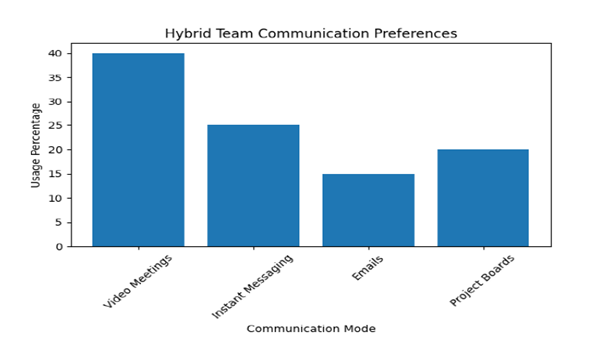
Illustrative data based on hybrid communication trends from industry surveys and hybrid work analysis.
Trend 5: Inclusive Communication Practice
Hybrid communication must counter the risk of proximity bias, where in-office employees receive more attention or opportunities. Intentional inclusive communication, ensuring remote voices are heard and celebrated, is essential to maintain equity and morale.
It is important to emphasise on inclusive leadership and diversity awareness as core elements, enabling leaders to craft communication strategies that promote fairness across teams.
In shifting from physical offices to hybrid realities, leadership communication has become a strategic advantage. A leader’s ability to connect teams, share vision, foster engagement and drive clarity across dispersed environments defines organisational resilience and performance in today’s world.
References
- McKinsey (2024) Hybrid can be healthy for your organization—when done right. Available at: https://www.mckinsey.com/… (Accessed: 14 February 2026).
- PwC (2024) Hybrid Working is the New Normal. Press release. Available at: https://press.pwc.be/… (Accessed: February 2026).
- Careertrainer.ai (2026) Hybrid Work Leadership Statistics. Available at: https://careertrainer.ai/… (Accessed: February 2026).
- WEF (2025) Future of Jobs Report. World Economic Forum. Available at: https://reports.weforum.org/… (Accessed: February 2026).