If you’ve spent more than five minutes in a Dubai coffee shop lately, you’ve probably heard the term “Free Zone” more often than you’ve heard people complaining about the humidity in August.
For years, Free Zones were the “cheat code” of Middle Eastern business—100% ownership, zero taxes, and enough paperwork to keep a small forest in business. But as we hurtle toward 2026, the landscape is shifting. It’s no longer just about tax havens; it’s about tech hubs, talent wars, and actually being sustainable.
At Westford for Business, we have our pulse on the business world and we’re seeing these shifts firsthand. Here is what the Free Zone ecosystem looks like in 2026.
1. The “Digital” Revolution: Virtual Desks, Real Money
Remember when a “Free Zone office” meant a tiny desk in a room with no windows? Those days are gone with the wind. With 2026, the “Meta-Zone” has arrived.
Free Zones are now offering hybrid licenses that exist simultaneously in the physical world and the metaverse. You can host a board meeting in a virtual skyscraper while sitting in your pajamas in Riyadh.
- The Trend: Digital twinning of Free Zone infrastructure.
- The Reality: You still can’t “virtually” drink the free office coffee, unfortunately.
2. Sustainability Isn’t Just for Reusable Straws
In 2026, “Green-Shoring” is the new outsourcing. With the UAE and Saudi Arabia pushing massive Net Zero targets, Free Zones are now competing on their carbon footprints.
- ESG Incentives: Expect discounted license renewals if your business meets specific sustainability metrics.
- Data Point: Recent 2025 reports indicate that 65% of MNCs now prioritize “Green Zones” for their regional headquarters to satisfy global investor requirements.
3. The Rise of the “Specialized Micro-Zone”
The era of the “General Trading” zone is fading. We are seeing a hyper-specialization that feels a bit like a high school cafeteria. You have the “AI Kids” over at the Dubai AI & Web3 Campus, the “Bio-Tech Crew” in specialized health clusters, and the “Gaming Nerds” in the rising e-sports zones of Abu Dhabi and Riyadh.
- Why it matters: In 2026, your neighbor isn’t just a random company; they are your potential collaborator (or the person who will headhunt your best developer).
The 2026 Free Zone Checklist
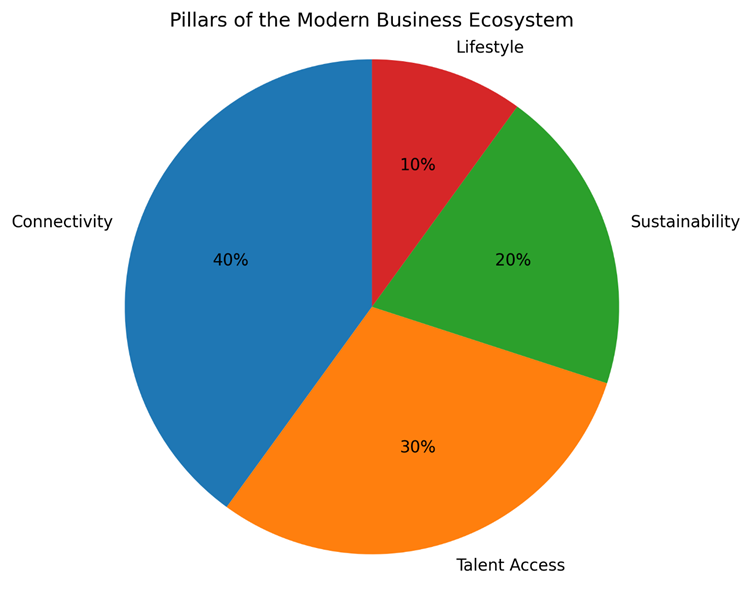
- Connectivity (40%): High-speed 6G integration & AI-automated customs.
- Talent Access (30%): Golden Visa facilitation and “Freelance-to-Corporate” pipelines.
- Sustainability (20%): Solar-powered hubs and zero-waste mandates.
- Lifestyle (10%): Because if there isn’t a high-end gym nearby, does the business even exist?
4. Talent Portability: The “War for Brains”
The biggest challenge for professionals in 2026 isn’t the commute—it’s staying relevant. Free Zones are transitioning from “Landlords” to “Learning Partners.”
With the Middle East’s gig economy expected to grow by 25% annually through 2026, zones are now offering “Talent Passports.” This allows professionals to move projects between different zones without the bureaucratic nightmare of cancelling and re-applying for visas every three weeks.
Pro Tip: If your company isn’t investing in corporate upskilling, your employees are likely currently browsing LinkedIn in the other tab.
5. AI is the New Administrative Assistant
If you’re still waiting three days for a trade name approval, you’re living in 2022. By 2026, Free Zone registries are almost entirely run by autonomous agents.
- Instant Licensing: In many zones, AI-led compliance checks allow for license issuance in under 15 minutes.
- The Catch: The AI is much harder to bribe with a box of fancy chocolates than the old PROs were.
How to Stay Ahead?

The 2026 ecosystem is fast, green, and incredibly specialized. For the working professional, this means your “soft skills” need to be as sharp as your technical ones. Whether you’re navigating the legalities of a DAO (Decentralized Autonomous Organization) in a Free Zone or trying to figure out how to report your carbon emissions, the learning curve is steep.
At Westford for Business, we don’t just watch these trends; we help you dominate them. From bespoke corporate training to navigating the complexities of the modern Middle Eastern market, we ensure your team isn’t just “in a zone,” but in the zone.
The Bottom Line: 2026 is about agility. If your business model is still stuck in a filing cabinet, it’s time for an upgrade.